There’s a real tension in adding a building to a garden you’ve spent years planting. Every square metre the structure occupies is a square metre that was growing something, and if that something was a nectar border, the butterflies notice before you do.
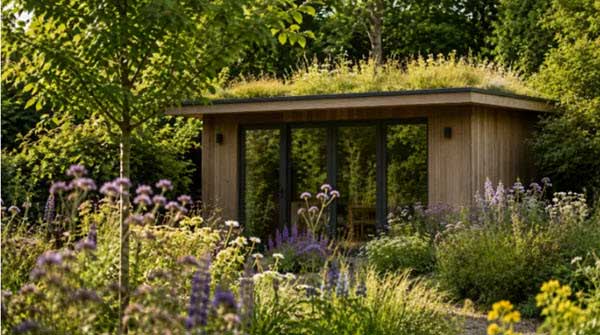
The objection is legitimate, and it deserves a better answer than “plant more elsewhere.” A garden building takes space, casts shade, changes drainage patterns and alters the wind across a plot. But done thoughtfully, garden rooms can end up hosting more pollinator planting than the lawn or patch of scrubby grass they usually replace — because a building gives you vertical surfaces, a roof, and sheltered edges that open ground never had.
Here’s how to plan it so the garden comes out ahead.
Site it where the planting isn’t
The first decision determines most of the others.
Garden buildings tend to get placed at the bottom of the plot by default, which is often exactly where the sunniest, most established borders are. Before settling on a position, spend a few days actually watching where the sun falls — morning, midday, late afternoon — and mark the areas that get six or more hours of direct sun. Those are your nectar-plant zones and they are the hardest thing to replace.
The best position for a building is usually a spot that is already underperforming: a shaded corner, a strip of thin grass against a boundary, an area with poor drainage where planting has never quite worked. These places exist in most gardens and they are precisely where a raised, insulated structure is least affected by the conditions that made them poor for planting.
Two practical points on siting:
North of the border, not south of it. A building placed on the northern side of a planting area casts its shadow away from the plants. Placed on the southern side, it shades them for most of the day. In the northern hemisphere this single decision does more for your existing planting than anything else on this list.
Watch the wind. Buildings create turbulence at their corners and a sheltered pocket on their leeward side. The sheltered pocket is genuinely valuable — butterflies avoid feeding in wind, and a calm sunlit area beside a wall will see more activity than an exposed border ten metres away. Plan a border there deliberately.
Replace the footprint, and then some
Work out the ground area the building will occupy and treat it as a debt to be repaid in planting elsewhere. This is easier than it sounds, because a building creates surfaces that bare ground does not.
The roof. A green roof on a garden building is one of the highest-value additions available for pollinators. A sedum mat is the common choice and it does support insects, but a wildflower or sedum-and-herb mix supports considerably more — the sedum monocultures sold as standard flower over a narrow window, whereas a mixed substrate with native species can give nectar from spring into autumn.
The requirement is structural. A saturated green roof is heavy — a shallow extensive system runs roughly 60 to 150 kg per square metre when wet, depending on substrate depth — so the building has to be designed for it from the outset. Retrofitting a green roof onto a structure not built for the load is not a small job. If a green roof is something you want, say so before anything is manufactured.
The walls. South and west-facing walls are warm, sheltered, and ideal for climbers. A wall of ivy, honeysuckle or a native climber gives you vertical planting on ground that would otherwise be a blank elevation. Ivy in particular flowers very late in the season, when almost nothing else does, and is one of the most valuable nectar sources in autumn.

The edges. The strip immediately around a building is often left as gravel or paving for practical reasons. Some of it needs to stay clear for access and drainage, but not all of it. A planted border on the sunny side, kept back far enough from the wall for airflow, converts dead space into forage.
What to plant where the building shades
Shade is the one genuine loss, and it’s worth being honest that shaded ground will not support the same nectar plants as open sun.
It will, however, support host plants — the species butterfly larvae eat, as distinct from the flowers adults feed on. Host planting is consistently under-provided in gardens because it is less showy, and several valuable host species tolerate partial shade perfectly well. If the new shaded strip becomes host habitat rather than nectar habitat, the garden’s overall value to butterflies can go up rather than down.
Which species suit depends entirely on which butterflies are local to you, so check what’s in your area before choosing. But the principle holds broadly: shade is a reason to change what you plant, not a reason to stop planting.
Drainage, and where the water goes
A roof sheds water that previously fell on soil. On a modest garden building that’s still a meaningful volume, and it has to go somewhere.
Piping it into a drain wastes it. Directing it into a water butt, a rain garden, or a shallow soakaway planted with species that tolerate periodic wet gives you irrigation and habitat at once. A damp planted area is valuable in its own right — it supports species that dry borders don’t — and it means the building’s roof is feeding the garden rather than draining it.
Plan this before the base goes in. Retrofitting drainage around a completed structure means digging up work you’ve already paid for.
Lighting, and a distinction worth making
Garden buildings almost always end up with external lighting, and there’s a real ecological cost to getting it wrong — but it’s worth being precise about who it affects.
Butterflies are diurnal. They roost at night and artificial light does not disrupt their feeding. Moths are the ones affected, along with a wide range of other nocturnal insects, and since moths are significant pollinators in their own right and a food source for bats and birds, the effect propagates through the same garden ecosystem you’re trying to support.
Three things reduce the harm considerably. Use warm colour temperatures — under 3,000K, and lower is better, because short-wavelength blue light is the most disruptive. Direct light downward with shielded fittings rather than letting it spill sideways across planting. And put it on a motion sensor or a timer so it isn’t burning all night when nobody is outside.
None of that compromises the usability of the building. It’s specification detail, decided once.
The order to do it in
Watch the sun for a week. Choose the least productive ground. Position the building north of what you want to protect. Decide on a green roof before manufacture, not after. Plan where the roof water goes before the base is laid. Plant the walls and the sheltered leeward corner. Convert the new shade into host planting rather than writing it off.
A building placed carelessly costs a garden its best border. Placed deliberately, it adds a roof, two or three warm walls, a sheltered feeding pocket and a source of irrigation — and the garden supports more than it did before.