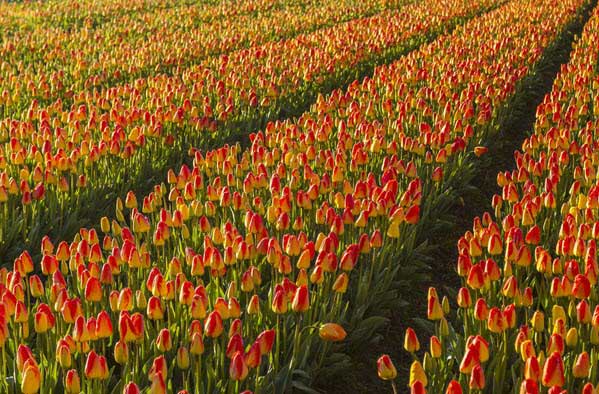
Ask most people what a gardener should see in the Netherlands and you will get one answer. Tulips. Endless ribbons of them, in April, stretching to the horizon.
They are worth seeing. But if you garden for butterflies, the tulip fields are not actually the most useful thing waiting for you there.
The Netherlands has quietly given modern pollinator gardening one of its most important ideas, and most visitors drive past it. Here is what to see, in the order that will teach you the most.
First, the Spectacle You Came For
The bulb fields bloom in a narrow window, roughly late March into early May. The effect is less like a garden than a painting laid across the landscape. Every gardener should stand in front of it once.
But hold onto one honest thought while you are there. What you are looking at is a monoculture in bloom, harvested for bulbs, timed to a few short weeks.
That is the opposite of what a butterfly garden needs to be. Butterflies require habitat across four life stages, egg through adult, which means host plants for caterpillars as well as nectar for adults, available across a long season rather than a single spectacular fortnight.
So enjoy the fields. Then go find the part that actually applies to your own yard.
Because the Netherlands’ real contribution to pollinator gardening did not come from the bulb industry at all. It came from a design movement the Dutch call the Dutch Wave, known internationally as the New Perennial Movement, which emerged in the 1970s as a reaction against rigid garden culture.
As the Van Eesteren Museum describes it, the movement favors gardening with nature, looser plant groupings, and finding beauty in a plant’s structure and form rather than only in its flowering period.
Hold that thought. It becomes the most useful thing you will bring home.
Getting There: Why Tulip River Cruises Suit This Particular Trip
There is a practical problem with a Dutch garden trip, and it is worth solving before you go.
The things you want to see are scattered. Bulb fields in the west, gardens near Utrecht in the center, more further out. Bloom timing is narrow and weather-dependent, so a rigid itinerary booked months ahead can miss the window entirely.
This is why Celebrity Cruises’ seasonal tulip season sailings suit this trip better than most. They run through the Netherlands and Belgium during bulb season, moving between destinations along the waterways, so you cover the spread-out geography without repacking in four hotels.
The Garden Actually Worth the Detour
Now the part almost nobody tells you about.
Near Utrecht sits a park called the Máximapark. Inside it is a public garden. The Dutch call it the Vlinderhof. That translates to Butterfly Garden.
Piet Oudolf designed it. You may know his work from New York’s High Line. But this garden did not begin with a city plan. Local residents pushed for it themselves.
The numbers are worth knowing. The garden holds about 15,000 perennials. Those span 98 species. Volunteers added roughly 34,000 spring bulbs on top of that. Oudolf advised on the choice. The goal was simple. A longer flowering season.
Note that detail, because it is the whole lesson. Bulbs were added not for spring spectacle but to lengthen the flowering period.
It is maintained by around forty volunteers ranging in age from nine to eighty. Entry costs nothing. The garden opens every day of the year. Sunrise to sunset, all seasons.
It opened in 2014. The site runs to about 5,000 square meters. Grasses make up a fifth of it.
The Idea You Can Actually Take Home
The Vlinderhof is the Dutch Wave made physical, and this is where that idea from earlier becomes practical.
That principle of valuing structure over bloom alone matters enormously for pollinators.
Think about how you value a plant. If you only value the flowers, you cut it back as soon as they fade. That is the instinct most of us have.
Now value the structure too. Suddenly you leave the seed heads. You leave the hollow stems standing all winter. And those stems matter. Many beneficial insects overwinter inside them.
Three ideas worth stealing for your own garden:
Plant in drifts, not dots. Group the same plant together. Butterflies spot large blocks of color from a distance. Single scattered plants are much harder to find. Drifts also just look deliberate rather than random.
Stretch the season deliberately. The Vlinderhof added tens of thousands of bulbs specifically for this. Early nectar matters. Late nectar matters even more. Both count for more than peak-summer abundance. The reason is simple. Midsummer is when food is everywhere. Spring and fall are when it runs short.
Let it stand. Do not tidy everything in autumn. Leave the grasses. Leave the spent perennials. They look untidy to some eyes. They are habitat, not neglect. The neighbors may need convincing.
Want to put these ideas to work at home? Our guide to building a butterfly garden covers the rest. It walks through host plants. It covers nectar plants. And it helps you stagger bloom times for your own region.
What to Actually Plan
If you go, go in a bloom window but do not build the whole trip around one.
The bulb fields peak in a short spring stretch. The Vlinderhof, by design, is worth visiting from late spring through October, and Oudolf’s plantings arguably look their most interesting in late summer when the grasses take over.
Which means a spring trip gives you the spectacle, and a late-summer trip gives you the lesson. If you only go once, choose based on which you actually want.
And take a notebook. Not for the tulips, which you will remember anyway. Take it for the plant combinations in a volunteer-run garden that has more to teach a butterfly gardener than any field of bulbs ever will.