That west-facing patio you love in October is quietly cooking your living room in July. I watched it happen at my own place: the backyard felt perfect by evening, but the kitchen behind it ran two degrees warmer than the rest of the house all summer, and the thermostat never stopped arguing with me. The fix wasn’t a bigger unit. It was the yard.
Here’s the deal. Your outdoor space and your cooling system share one thermal budget. Every tree you plant, every screen you hang, every shade sail you tension decides how much heat reaches your walls before the air conditioner ever gets a vote. Treat the yard as cooling equipment and you’ll get more comfort from the same machine. That’s the whole promise here: a few design decisions, a couple of habits, and a yard that works with your system instead of against it. If you ever need a professional to check the machine side of that equation, booking air conditioning maintenance in little rock is the sensible first move before you spend a dime on landscaping.
One honest caveat up front. Shade and airflow help, but they don’t fix a unit that’s low on charge or running a dirty coil. Design buys you headroom; maintenance protects it.
Why the west side of your yard matters more than the rest
Late afternoon sun hits hardest, and in a place like Arkansas it arrives with humidity attached. A tree, fence, or screen on the western exposure blocks the sun when the outdoor temperature is peaking and your system is already working its hardest. The same plant on the east side earns you far less.
I’d rather you plant one well-placed shade tree than five scattered shrubs. Position beats quantity, and a deciduous tree gives you summer shade and winter sun, which is exactly the trade you want. Vines on a trellis work too, and bamboo screens go up in an afternoon.
Then there’s the outdoor unit itself. According to the U.S. Department of Energy, a shaded condenser doesn’t have to fight as much ambient heat to reject what it pulls from your house. Build that shade with a fence, a screen, or a shrub border, but leave a few feet of clear space around the unit. An air conditioner boxed in by enthusiastic landscaping is worse off than one sitting in the open.
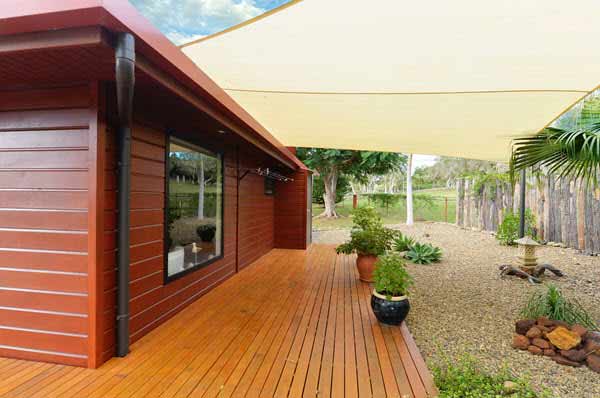
Hardscape counts against you, by the way. A stamped concrete patio, a stone walkway, and a brick retaining wall all soak up solar energy during the day and release it toward your walls into the evening. I’d take a small deck with a shade sail over a massive slab with no cover, every single time.
How to build a courtyard that blocks heat without blocking air
Here’s the part that trips people up. You want shade above and airflow through. Two categories of screen solve that, and you’ll probably want a mix.

- Open-weave shade sails and pergola slats cut direct sun while letting trapped hot air rise and escape.
- Lattice panels and slatted fences give you privacy and shade while still passing breeze, unlike a solid wall of boards.
- Deciduous vines on a trellis deliver leaf cover in summer and drop it in winter, so you’re not blocking the sun you’ll want in January.
The failure mode is a fully walled courtyard with a solid roof. It looks fantastic in a magazine and turns into a solar oven by mid-afternoon, and all that stored heat radiates straight into the room on the other side of the wall. If you must go solid on one side, keep at least one direction open and face it toward the prevailing summer breeze.
Consider your patio surface too. Light colored stone or composite decking reflects more energy than dark pavers or black mulch, and wetting down a hot patio in late afternoon actually does something measurable for the rooms adjacent to it. Cheap trick, real effect.
Smart scheduling: work with the heat, not against it
Outdoor living and indoor cooling follow the same daily rhythm, so plan around it instead of fighting it.
- Cook and bake earlier. The oven, the grill, and the dryer all dump heat into the house. Run them in the morning or after sunset when the system has slack.
- Open the house at night. When the overnight low drops, pull in cool air through screened windows, then close everything up by mid-morning. Screens matter here, since open windows and no screens invite every mosquito in the county.
- Move the thermostat in small steps. A few degrees up while you’re at work is fine. Huge setbacks just make the unit sprint to recover, and long runtimes are where efficiency quietly disappears.
- Keep the filter honest. Dust from patio work, pollen season, and general yard grit all end up in that filter. The U.S. Environmental Protection Agency ties indoor air quality directly to how well your system moves and filters air, so a clogged filter taxes both comfort and air quality at once.
- Time your projects. Sanding, staining, and demo work throw fine dust into the air. Knock those out on mild days, and check the filter the week after.
Notice that none of those steps cost much. They’re scheduling decisions, and scheduling is free.
My screen-first rule, and when to break it
If you take one idea from this, take this one: screen first, shade second, plant third. I call it the screen-first rule, and it holds up because screens go up fast, cost little, and let you test what actually works before you commit to something with roots.
Break it in exactly one case. If you have a bare western wall with full afternoon exposure, plant the tree now and let it start growing while you sort out the rest. Trees are the only element here that gets better with time, and a five year head start is worth more than a perfect plan you execute two summers from now.
Pair the whole approach with a seasonal check on the equipment itself, ideally in spring before the first really hot week arrives. Coils, refrigerant charge, and drain lines are the parts your landscaping can’t influence, and they’re the reason a well-designed yard still needs a well-maintained machine. Shade and screens reduce the load. Maintenance keeps the machine able to carry it.
So walk your yard this weekend and ask one question at each wall: what’s hitting this surface between two and six in the afternoon? Answer that honestly, fix the worst exposure first, and your thermostat will thank you before fall.